The Risks of Success: Why Black Swans Trigger at the Peak

The most dangerous moment for any system--be it a financial market, a corporate institution, or a human biography--is not necessarily the trough. It is often the point at which the system appears most successful, most coherent, and least vulnerable. This is the Paradox of the Zenith: success concentrates energy, narrows optionality, and turns small disturbances into structural events.
The revised FLUXARA-1 audit corpus now supports this claim through two distinct research frames. The human biographical audit evaluates year-level shocks across 100 globally influential figures, while the financial benchmark audit evaluates GOLD (2009-2018) and BTC (2019-2025) as long-cycle economic systems. The shared object is the Black Swan Index (BSI): an ex-ante structural risk score, not a narrative label applied after the fact.
In the human audit, FLUXARA-1 processed 1,610 trigger rows: 1,519 historical in-sample events, 1,466 verified matches, 53 rejected rows, and 91 out-of-sample rows held pending. The verified in-sample match rate is 96.51% (1,466/1,519) under a four-gate evidence filter. In the finance audit, the cross-asset BSI Historical Audit Score is 87.75%, with 84.90% for GOLD and 90.60% for BTC. These figures define the current audited evidence base.
(You can click on the Full Audit button below this article to read the detailed backtest and semantic audit reports verified by our team.)
I. The Illusion of Stability
 Peak success can hide structural fragility
In the revised research frame, "success" is not treated as a moral category. It is treated as a structural condition: high agency, high visibility, high capital concentration, and high dependence on a narrow operating architecture. In a human biography, this may appear as sudden fame, institutional ascent, career metamorphosis, or public crisis. In a financial market, it may appear as valuation saturation, leverage concentration, liquidity crowding, or late-cycle momentum.
The human semantic rubric is explicitly directionally agnostic: BSI does not measure only negative crises. It measures the intensity of a structural event, whether the event is destructive collapse or constructive rupture. The strongest human tiers therefore include both Point Zero (PZ) events, where the prior trajectory can no longer continue under the same causal framework, and Black Swan (BS) events, where the old structure is shattered by crisis or unprecedented success.
The human audit's tier distribution confirms this high-intensity emphasis: PZ accounts for 567 triggers (35.2%), BS for 540 (33.5%), SF for 431 (26.8%), and FB for 72 (4.5%) across the 1,610 processed triggers. The dominant semantic labels--Structural Metamorphosis / Career Pivots (16.8%), Destructive Restructuring (15.7%), and Systemic Instability (15.7%)--jointly account for 48.2% of all classified events. The model is therefore not merely detecting "failure"; it is detecting moments where agency, continuity, public memory, or institutional position must be renegotiated.
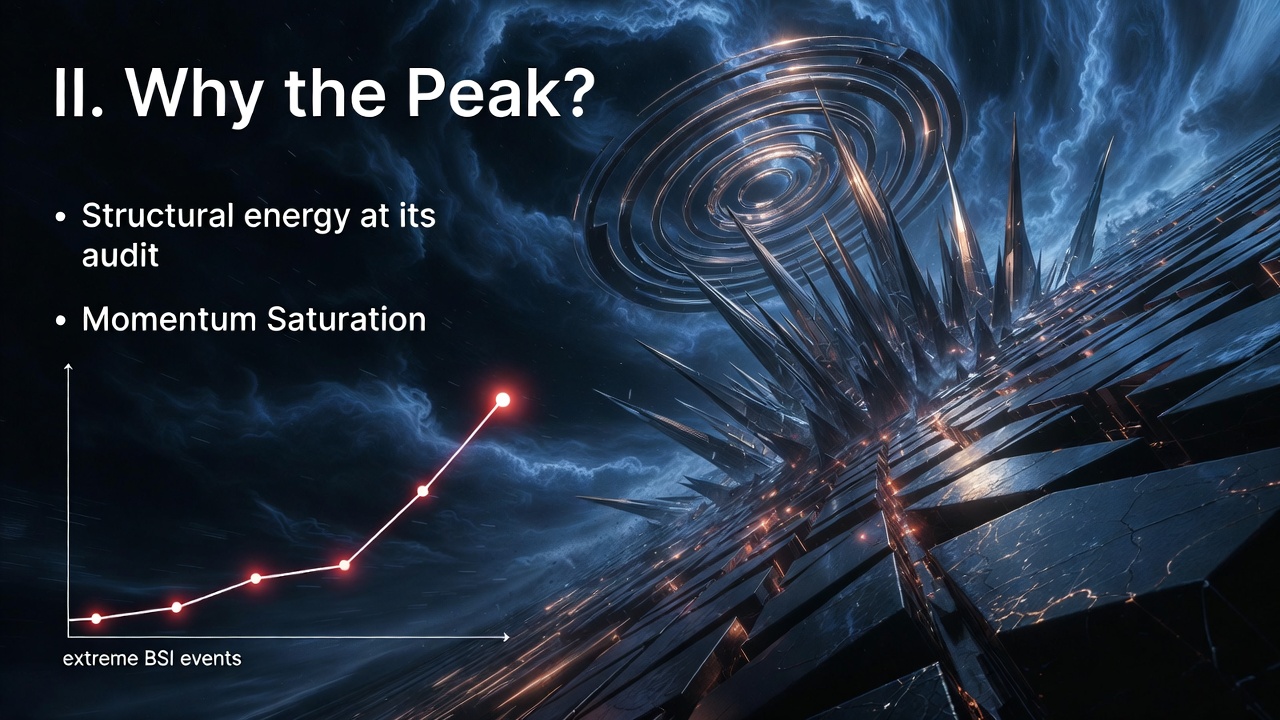
II. Why the Peak?
 Trigger a Black Swan event
The peak is dangerous because it can hide fragility behind visible achievement. The financial audit translates this into economic terms through five structural risk vectors: negative velocity, negative acceleration, overvalued regime risk, exogenous calendar risk premium, and tail-risk / volatility shock anomaly. In the finance rubric, BSI is audited as a leading indicator of latent systemic financial fragility, using a +/- 1 year temporal tolerance window against realized stress.
This distinction matters. FLUXARA-1 is not evaluated as a direct price forecaster, nor as a biographical fortune-teller. In finance, the audit tests whether BSI aligns with realized stress, regime transitions, and capital-flow dynamics. In the human audit, the model is tested against verified public biographical events using identity, temporal, source, and event-granularity gates. In both domains, the question is not "did the model tell a story?" but "did the structural signal align with an observable transition?"
At the peak, three cross-domain mechanisms converge:
- Momentum Saturation: Growth reaches a ceiling where expansion no longer absorbs friction; it amplifies it.
- Phase Overvaluation: The financial rubric's
Phi_3risk vector captures the moment when cycle alignment overlaps with peak-zone vulnerability. - Agency Rigidity: The human rubric captures moments where continuity, social role, legal status, public memory, or institutional identity can no longer remain unchanged.
III. Target-Year Kinetics: The N+1 Styles of Impact
 The N+1 Styles of Impact
BSI is audited at the year level. It does not claim intra-day precision in markets or exact life-event timing for individuals. Both audit reports use a cycle-level temporal frame: a target year can be reconciled with a verified event or stress condition within a N - 1, N, or N + 1 window when the causal chain supports that alignment.
- ADVERSE: The Compression Threshold
Adverse impact occurs when previously accumulated energy must be de-levered. In financial economics, this is the language of negative velocity, negative acceleration, liquidation, and forced repricing. The finance audit identifies major stress examples in the 2013 GOLD liquidation / taper-tantrum phase and the 2022 BTC crypto-winter breakdown, where the BSI framework operated as a structural vulnerability sensor rather than a trailing price mirror.
In human biographies, the same mode appears as destructive restructuring, systemic instability, health collapse, exile, legal shock, reputational rupture, or institutional displacement. The key anthropological issue is not pain alone; it is the forced renegotiation of agency and social continuity.
- REVIVAL: The Over-Acceleration Paradox
Revival is structurally ambiguous. It can be genuine recovery, but it can also be over-acceleration before the system has rebuilt its buffers. This is where the human rubric's directionally agnostic design matters most: a breakthrough, sudden fame, major publication, career pivot, or institutional promotion can be as structurally disruptive as a crisis if it renders the previous operating system obsolete.
The financial audit shows the calmer side of this mechanism in BTC's 2023-2025 re-accumulation phase, where BSI cooled into a safer baseline range while QOS captured the transition from speculative leverage toward post-ETF normalization. Revival becomes stable only when the prior compression has actually resolved.
- ANCHOR: The Inertia Wall
Anchor represents fixation: the system has achieved coherence, but coherence can harden into inertia. In finance, this corresponds to peak-cycle vulnerability and limits-of-arbitrage conditions. The GOLD audit is instructive: the 2017 BSI threshold reached 100.00%, acting as a strong lead warning of structural fracture even though the realized macro stress layer remained muted in the same calendar year.
In biographical terms, Anchor is the public form of a life: a role, a reputation, an office, a canonical work, or a legacy position. When that form becomes too rigid, even a small shock can force disproportionate reclassification. This is why PZ and BS tiers dominate the human trigger distribution: the audit is concentrated around moments where the old identity architecture can no longer govern the next phase.
Cross-domain failure modes
Anthropological failure mode: BSI rises when agency, continuity, public memory, or institutional identity must be renegotiated. The event may be destructive or constructive; the common property is structural discontinuity.
Financial-economic failure mode: BSI rises when momentum, valuation, liquidity, and stress transmission become tightly coupled. The signal is most useful as an early warning of latent fragility, not as a same-day price forecast.
Research boundary: Both audit reports operate at annual step-size with a +/- 1 year tolerance window. The claim is cycle-level structural alignment, not deterministic event prediction.
IV. The Strategic Compass
 Structural Event Horizon
For strategists, researchers, and institutional leaders, the revised evidence base changes the interpretation of "risk at the peak." The relevant question is not whether success is good or bad. The question is whether success has produced a system so tightly coupled that the next transition must be violent.
The human audit demonstrates that the BSI framework can classify high-intensity biographical transitions with 96.51% verified in-sample alignment under strict semantic gates. The finance audit demonstrates that BSI functions as a leading structural risk sensor across two very different asset classes, with 87.75% cross-asset average audit performance and 100.00% turning-year precision across the evaluated GOLD and BTC windows.
The practical implication is methodological rather than prescriptive. Tracking BSI is not about claiming certainty over a person's life or an asset's next print. It is about quantifying how much structural risk success is creating, and whether the system has enough adaptive slack to survive the next phase transition.
Related Posts

#28 BSI Structural Analysis: Vincent van Gogh
FLUXARA-1 audit of 15 matched BSI events for Vincent van Gogh, spanning 1866–1938; the most frequent verified classification is Destructive Restructuring.

#29 BSI Structural Analysis: Virginia Woolf
FLUXARA-1 audit of 11 matched BSI events for Virginia Woolf, spanning 1888–1969; the most frequent verified classification is Destructive Restructuring.

#30 BSI Structural Analysis: Winston Churchill
FLUXARA-1 audit of 16 matched BSI events for Winston Churchill, spanning 1882–1959; the most frequent verified classification is Destructive Restructuring.
