#15 BSI Structural Analysis: Mahatma Gandhi
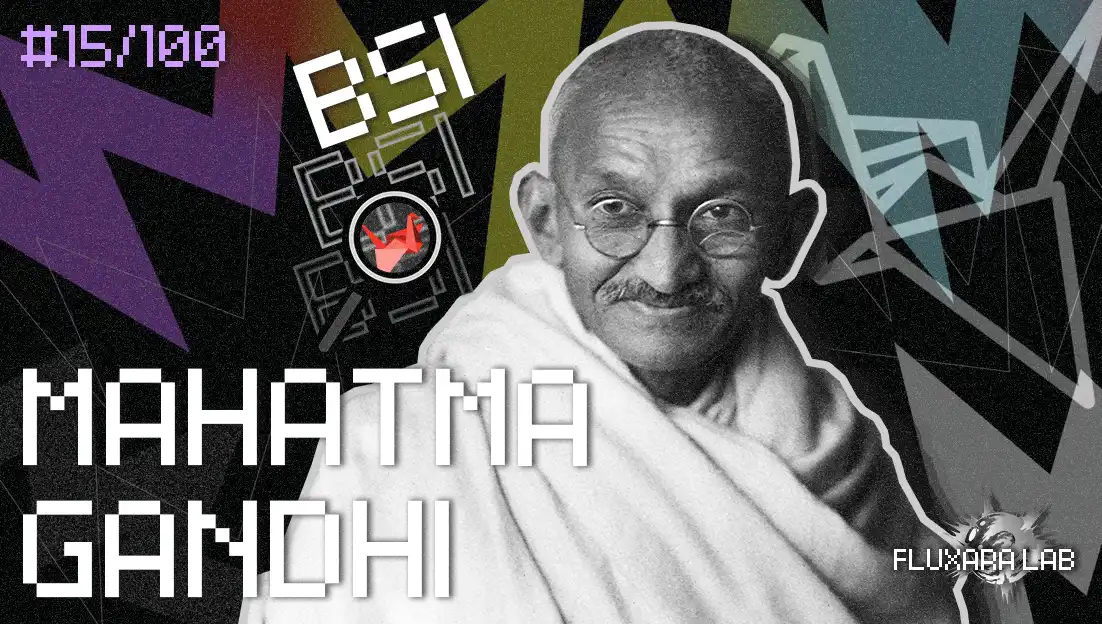
What this audit records
This public profile draws only on 15 matched records in the frozen FLUXARA-1 humanoid audit for Mahatma Gandhi. The visible timeline spans 1877–1954, with BSI values from 79.7% to 100.0% (mean 92.4%).
In this research frame, BSI describes the intensity of a biographical structural event; it is directionally agnostic. A high marker can therefore refer to crisis, breakthrough, institutional change, or durable legacy—not a moral judgement about the person or event. To learn more about how energy cycles impact individuals, read our analysis on what is a black swan person.
Tier distribution: Point Zero (PZ): 5 events (33%); Black Swan (BS): 7 events (47%); Shock Factor (SF): 3 events (20%).
The table below reproduces each verified event exactly as scored in the audit dataset. All events passed the four-gate evidence filter (Identity, Temporal, Source, Event Granularity) and received a [Matched] verification status. Rows marked by the source label as tolerance cases use the rubric's allowed ±1-year temporal window.
Verified BSI Trigger Timeline
| Year | BSI% | Tier | Label | Verified Event |
| 1877 | 100.0 | PZ | Structural Metamorphosis / Career Pivots | In 1878, at the age of nine, Mohandas Gandhi entered the local school in Rajkot, where he began his formal education in arithmetic, history, the Gujarati language, and geography. |
| 1882 | 89.7 | BS | Destructive Restructuring | In 1883: The 13-year-old Mohandas Gandhi was married to 14-year-old Kasturbai Gokuldas Kapadia in an arranged ceremony in Rajkot, an event that caused him to lose a year of schooling and fundamentally altered his domestic and social status. |
| 1886 | 93.3 | BS | Destructive Restructuring | In 1886: Following the death of his father in late 1885, the 16-year-old Mohandas Gandhi experienced the birth and subsequent death of his first child, a sequence of personal tragedies that profoundly destabilized his early domestic life. |
| 1891 | 90.6 | BS | Destructive Restructuring | In 1891: Mohandas Karamchand Gandhi was called to the bar at the Inner Temple in London, only to return to India to discover his mother had died during his absence and subsequently face the failure of his initial law practice in Bombay. |
| 1895 | 100.0 | PZ | Structural Metamorphosis / Career Pivots | In 1895: Mohandas Gandhi, at the age of 26, prepared a formal legal brief for the Natal Assembly to advocate for the voting rights of the Indian community, marking a decisive shift in his career toward public political representation. |
| 1904 | 100.0 | PZ | Structural Metamorphosis / Career Pivots | In 1904: Mahatma Gandhi relocated the publishing office of his newspaper, Indian Opinion, to a newly established communal settlement in Phoenix, near Durban, where he implemented a new work ethic based on shared land ownership, communal labor, and self-sufficient agricultural production. |
| 1913 | 93.1 | BS | Destructive Restructuring | In 1913: Mahatma Gandhi led the Great March of thousands of Indian indentured laborers across the Transvaal border in South Africa, a radical act of mass civil disobedience that shattered the existing legal framework and forced a fundamental restructuring of the colonial government's labor policies. |
| 1922 | 100.0 | PZ | Structural Metamorphosis / Career Pivots | In 1922: Following the violent Chauri Chaura massacre, Mahatma Gandhi formally called off the Non-cooperation movement, marking a decisive shift in his political strategy and the trajectory of the Indian independence struggle. |
| 1927 | 80.9 | SF | Systemic Instability | In 1927: Mahatma Gandhi published the first volume of his autobiography, 'The Story of My Experiments with Truth', which publicly codified his personal life and philosophical development for an international audience. |
| 1931 | 100.0 | PZ | Structural Metamorphosis / Career Pivots | In 1931: Mahatma Gandhi negotiated and signed the Gandhi-Irwin Pact with the Viceroy of India, Lord Irwin, which secured the release of political prisoners and facilitated Gandhi's participation in the Second Round Table Conference in London as the sole representative of the Indian National Congress. |
| 1936 | 82.2 | SF | Systemic Instability | In 1936, Mahatma Gandhi publicly addressed the conversion of his son, Harilal, to Islam in his journal Harijan, expressing his belief that the act was motivated by material gain and exploitation rather than genuine faith. |
| 1940 | 95.9 | BS | Destructive Restructuring | In 1939: Mahatma Gandhi and the Indian National Congress formally withdrew their support for the British Raj following the Viceroy's unilateral declaration of war on Germany, an act that shattered the existing framework of political cooperation and set the stage for the radical escalation of the independence movement. |
| 1945 | 90.0 | BS | Destructive Restructuring | In 1946: Mahatma Gandhi initiated a solitary walking pilgrimage through the riot-torn villages of Noakhali, Bengal, effectively abandoning his role in high-level constitutional negotiations to address the communal violence that signaled the collapse of his vision for a united India. |
| 1949 | 91.2 | BS | Destructive Restructuring | In 1949: The Indian government finalized the legal fallout of Mahatma Gandhi's assassination by sentencing his killers, Nathuram Godse and Narayan Apte, to death on 8 November and subsequently executing them by hanging at Ambala jail on 15 November. |
| 1954 | 79.7 | SF | Legacy Resonance (Moderate — SF) | In 1954: The Government of India's Publication Division officially released the first edition of the comprehensive biographical work 'Mahatma Gandhi - His Life in Pictures,' while simultaneously, the Delhi State Congress Committee held a major public commemorative meeting in New Delhi to mark the sixth anniversary of his death. |
Structural Summary
Across 15 matched records, the peak BSI score of 100.0% occurs in 1877 (classified as Structural Metamorphosis / Career Pivots, PZ-tier).
PZ/BS ratio: 12 of 15 matched records (80%). Mean BSI score: 92.4%.
Age-band distribution, calculated as audit year minus the frozen birth-year profile: before age 18: 3 records (20%); ages 18–64: 7 records (47%); age 65+: 5 records (33%).
Temporal tolerance use: 4 records (27%) use the rubric's allowed ±1-year window.
A run of 2 adjacent PZ-tier records appears between 1895 and 1904; this is a chronological audit pattern, not a causal claim.
The dominant event classifications are: Destructive Restructuring (7); Structural Metamorphosis / Career Pivots (5); Systemic Instability (2).
Data: FLUXARA-1 Humanoid Biographical Audit (96.51% verified in-sample match rate, 1,466 matched / 1,519 in-sample events). Methodology: four-gate evidence filter per the BSI Semantic Rubric v1.0. This analysis is part of a 100-figure audit series for academic research; it does not constitute life, financial, or medical advice.
No Guarantee of Future Projections: Out-of-sample projections are mathematically generated scenarios based on cyclical boundary equations and do not represent guaranteed forecasts.
Assumption of Risk: Any reliance on the materials, metrics, or scripts in this repository is at the user's sole risk. Fluxara Research Lab, its developers, and contributors assume no liability for any direct or indirect losses resulting from the use or interpretation of these assets.
Limitations & Structural Asymmetry (The 1,610 vs. 6,390 Problem): The current benchmark design exhibits a critical statistical constraint: it evaluates performance exclusively within the Alert-Tier Population (N = 1,610 years, where BSI ≥ 60%), achieving a 96.51% semantic match rate. While this validates the engine's Target-Event Precision, it does not define its Specificity or Type I Error Rate (False Positives) across the remaining ~6,390 non-alert background years within the audited 8,000+ year-pool. This asymmetry is primarily due to Information Omission Bias in public historical archives, where uneventful years lack structured validation data. Consequently, the 96.51% score must be interpreted as a measure of semantic consistency in crisis mapping, not as a complete proof of the engine's discrimination capacity. A stratified random-sample pilot to establish a validated True Negative baseline for the 6,390 background years is planned under our model risk management pipeline, but has not yet commenced.
Related Posts

#28 BSI Structural Analysis: Vincent van Gogh
FLUXARA-1 audit of 15 matched BSI events for Vincent van Gogh, spanning 1866–1938; the most frequent verified classification is Destructive Restructuring.

#29 BSI Structural Analysis: Virginia Woolf
FLUXARA-1 audit of 11 matched BSI events for Virginia Woolf, spanning 1888–1969; the most frequent verified classification is Destructive Restructuring.

#30 BSI Structural Analysis: Winston Churchill
FLUXARA-1 audit of 16 matched BSI events for Winston Churchill, spanning 1882–1959; the most frequent verified classification is Destructive Restructuring.
