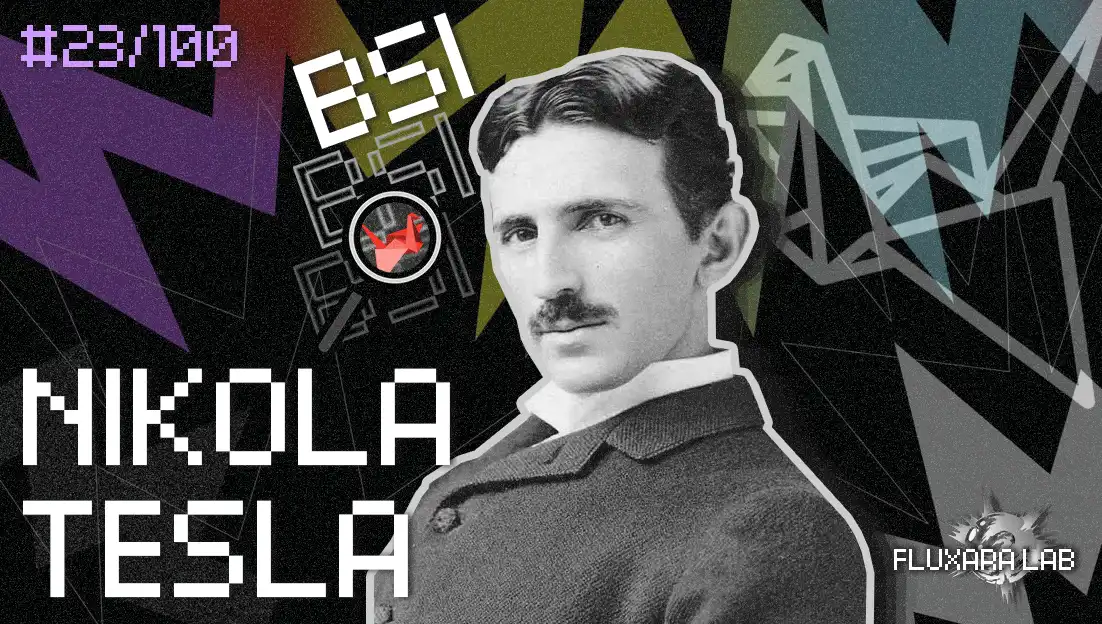
#23 BSI Structural Analysis: Nikola Tesla
What this audit records
This public profile draws only on 18 matched records in the frozen FLUXARA-1 humanoid audit for Nikola Tesla. The visible timeline spans 1860–1941, with BSI values from 76.7% to 100.0% (mean 92.7%).
In this research frame, BSI describes the intensity of a biographical structural event; it is directionally agnostic. A high marker can therefore refer to crisis, breakthrough, institutional change, or durable legacy—not a moral judgement about the person or event. To learn more about how energy cycles impact individuals, read our analysis on what is a black swan person.
Tier distribution: Point Zero (PZ): 8 events (44%); Black Swan (BS): 6 events (33%); Shock Factor (SF): 3 events (17%); Fragility Baseline (FB): 1 event (6%).
The table below reproduces each verified event exactly as scored in the audit dataset. All events passed the four-gate evidence filter (Identity, Temporal, Source, Event Granularity) and received a [Matched] verification status. Rows marked by the source label as tolerance cases use the rubric's allowed ±1-year temporal window.
Verified BSI Trigger Timeline
| Year | BSI% | Tier | Label | Verified Event |
| 1860 | 79.9 | SF | Systemic Instability | In 1861: Nikola Tesla's older brother tragically died in an accident when Tesla was five years old, an event that profoundly impacted him and shaped his obsessive and eccentric personality later in life. |
| 1864 | 100.0 | PZ | Structural Metamorphosis / Career Pivots | In 1864: Nikola Tesla attended elementary school, moving between Smiljan and Gospic, which marked a significant structural change in his early life and educational environment. |
| 1869 | 99.6 | PZ | Structural Metamorphosis / Career Pivots | In 1870: Nikola Tesla commenced his studies at the Realschule in Karlstadt, Germany, marking a significant transition in his formal education. |
| 1873 | 94.5 | BS | Destructive Restructuring | In 1873: Nikola Tesla graduated from the Higher Real Gymnasium in Karlovac, effectively concluding his secondary education and transitioning into his professional life as an electrical pioneer. |
| 1878 | 92.5 | BS | Destructive Restructuring | In 1878: After departing Graz without completing his degree, Nikola Tesla contracted cholera, and during his subsequent recovery, he experienced intense visions through which he claimed to have deciphered the principles of alternating current. |
| 1882 | 100.0 | PZ | Structural Metamorphosis / Career Pivots | In 1882: Nikola Tesla moved to Paris to join the Continental Edison Company at Ivry-sur-Seine, where he gained extensive practical experience in electrical engineering and conceived the principle of the rotating magnetic field that would later define his induction motor. |
| 1887 | 76.7 | FB | Directional Shift / Accumulation | In 1887: Nikola Tesla, after a period of financial hardship, established the Tesla Electric Company in New York with new investors, securing a contract for a third of the company's profits and subsequently applying for seven patents, including one for his two-phase AC induction motor. |
| 1891 | 100.0 | PZ | Structural Metamorphosis / Career Pivots | In 1891: Nikola Tesla agreed to release George Westinghouse from the royalty payment clause in their contract, effectively renegotiating his financial arrangement to ensure the survival of Westinghouse Electric during a period of severe economic instability. |
| 1896 | 81.1 | SF | Systemic Instability | In 1896: The hydroelectric power plant at Niagara Falls, designed by Nikola Tesla, commenced powering the city of Buffalo, New York, a highly publicized achievement that significantly propelled the adoption of alternating current (AC) electricity as the global power system. |
| 1900 | 92.9 | BS | Destructive Restructuring | In 1900: Nikola Tesla secured crucial financial backing from financier J.P. Morgan to commence the ambitious construction of the Wardenclyffe Tower, intended as a global wireless power and communication system on Long Island. |
| 1909 | 100.0 | PZ | Structural Metamorphosis / Career Pivots | In 1909: Nikola Tesla publicly advocated for his World Wireless System, marking a strategic pivot in his efforts to secure his legacy and technological vision following the abandonment of his Wardenclyffe project. |
| 1914 | 98.0 | PZ | Critical Disruption / Systemic Shock | In 1915: Nikola Tesla's ambitious Wardenclyffe wireless power transmission site fell into foreclosure, marking a significant financial and professional setback. |
| 1918 | 100.0 | PZ | Structural Metamorphosis / Career Pivots | In 1917: Nikola Tesla was awarded the Edison Medal, recognized as the most coveted electrical prize in the United States. |
| 1923 | 77.8 | SF | Systemic Instability | In 1923: Nikola Tesla was evicted from the St. Regis Hotel in New York City due to his accumulation of unpaid bills and complaints regarding the mess created by the pigeons he kept in his room. |
| 1927 | 97.5 | PZ | Structural Metamorphosis / Career Pivots | In 1926: Nikola Tesla, in a public interview, made remarkably prescient predictions about future technology, including wireless handheld communication devices and the evolving role of women in society. |
| 1932 | 92.8 | BS | Destructive Restructuring | In 1932, Nikola Tesla utilized his annual birthday press conference to publicly claim the invention of a motor powered by cosmic rays, a declaration intended to fundamentally challenge and replace the established physical and energy-generation paradigms of the era. |
| 1936 | 89.1 | BS | Destructive Restructuring | In 1937: Nikola Tesla, living in reclusive isolation at the Hotel New Yorker, finalized his 'dynamic theory of gravity' and authored a treatise on charged particle beam weapons, marking the total shift of his professional existence from practical engineering to the pursuit of unverified, theoretical superweapons. |
| 1941 | 96.1 | BS | Destructive Restructuring | In 1941: Nikola Tesla, facing the escalation of global conflict, attempted to secure the adoption of his 'Teleforce' defensive weapon by sending technical diagrams and proposals to the U.S. War Department, the United Kingdom, the Soviet Union, and Yugoslavia. |
Structural Summary
Across 18 matched records, the peak BSI score of 100.0% occurs in 1864 (classified as Structural Metamorphosis / Career Pivots, PZ-tier).
PZ/BS ratio: 14 of 18 matched records (78%). Mean BSI score: 92.7%.
Age-band distribution, calculated as audit year minus the frozen birth-year profile: before age 18: 4 records (22%); ages 18–64: 9 records (50%); age 65+: 5 records (28%).
Temporal tolerance use: 6 records (33%) use the rubric's allowed ±1-year window.
A run of 3 adjacent PZ-tier records appears between 1909 and 1918; this is a chronological audit pattern, not a causal claim.
The dominant event classifications are: Structural Metamorphosis / Career Pivots (7); Destructive Restructuring (6); Systemic Instability (3).
Data: FLUXARA-1 Humanoid Biographical Audit (96.51% verified in-sample match rate, 1,466 matched / 1,519 in-sample events). Methodology: four-gate evidence filter per the BSI Semantic Rubric v1.0. This analysis is part of a 100-figure audit series for academic research; it does not constitute life, financial, or medical advice.
No Guarantee of Future Projections: Out-of-sample projections are mathematically generated scenarios based on cyclical boundary equations and do not represent guaranteed forecasts.
Assumption of Risk: Any reliance on the materials, metrics, or scripts in this repository is at the user's sole risk. Fluxara Research Lab, its developers, and contributors assume no liability for any direct or indirect losses resulting from the use or interpretation of these assets.
Limitations & Structural Asymmetry (The 1,610 vs. 6,390 Problem): The current benchmark design exhibits a critical statistical constraint: it evaluates performance exclusively within the Alert-Tier Population (N = 1,610 years, where BSI ≥ 60%), achieving a 96.51% semantic match rate. While this validates the engine's Target-Event Precision, it does not define its Specificity or Type I Error Rate (False Positives) across the remaining ~6,390 non-alert background years within the audited 8,000+ year-pool. This asymmetry is primarily due to Information Omission Bias in public historical archives, where uneventful years lack structured validation data. Consequently, the 96.51% score must be interpreted as a measure of semantic consistency in crisis mapping, not as a complete proof of the engine's discrimination capacity. A stratified random-sample pilot to establish a validated True Negative baseline for the 6,390 background years is planned under our model risk management pipeline, but has not yet commenced.
Related Posts

#28 BSI Structural Analysis: Vincent van Gogh
FLUXARA-1 audit of 15 matched BSI events for Vincent van Gogh, spanning 1866–1938; the most frequent verified classification is Destructive Restructuring.

#29 BSI Structural Analysis: Virginia Woolf
FLUXARA-1 audit of 11 matched BSI events for Virginia Woolf, spanning 1888–1969; the most frequent verified classification is Destructive Restructuring.

#30 BSI Structural Analysis: Winston Churchill
FLUXARA-1 audit of 16 matched BSI events for Winston Churchill, spanning 1882–1959; the most frequent verified classification is Destructive Restructuring.
