#22 BSI Structural Analysis: Nelson Mandela
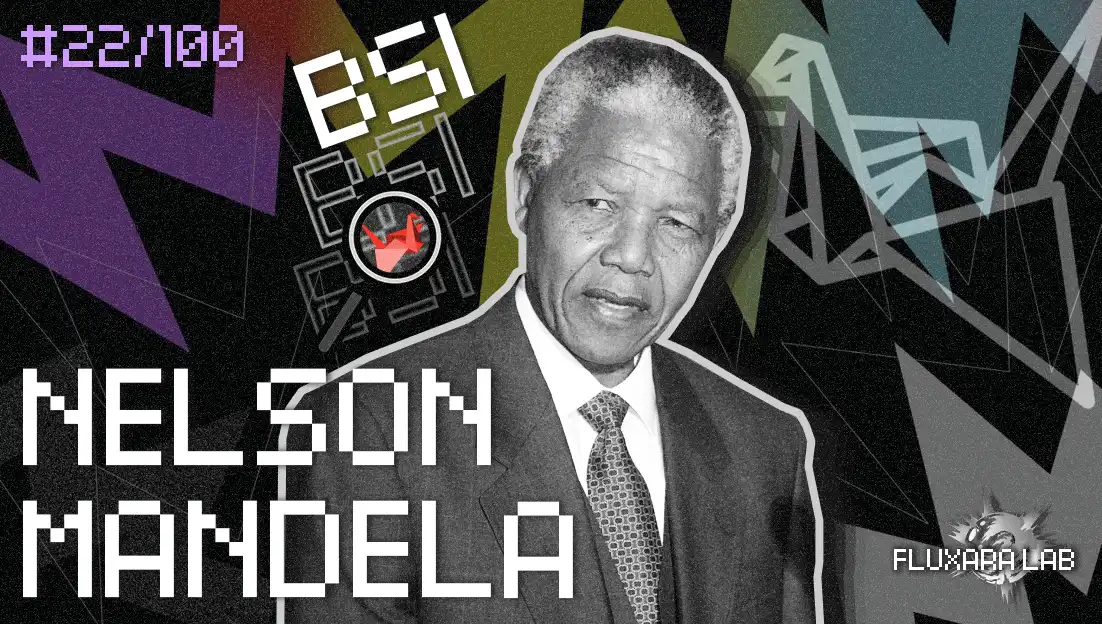
What this audit records
This public profile draws only on 17 matched records in the frozen FLUXARA-1 humanoid audit for Nelson Mandela. The visible timeline spans 1926–2003, with BSI values from 77.6% to 100.0% (mean 94.2%).
In this research frame, BSI describes the intensity of a biographical structural event; it is directionally agnostic. A high marker can therefore refer to crisis, breakthrough, institutional change, or durable legacy—not a moral judgement about the person or event. To learn more about how energy cycles impact individuals, read our analysis on what is a black swan person.
Tier distribution: Point Zero (PZ): 8 events (47%); Black Swan (BS): 6 events (35%); Shock Factor (SF): 3 events (18%).
The table below reproduces each verified event exactly as scored in the audit dataset. All events passed the four-gate evidence filter (Identity, Temporal, Source, Event Granularity) and received a [Matched] verification status. Rows marked by the source label as tolerance cases use the rubric's allowed ±1-year temporal window.
Verified BSI Trigger Timeline
| Year | BSI% | Tier | Label | Verified Event |
| 1926 | 100.0 | PZ | Critical Disruption / Systemic Shock | In 1927: Nelson Mandela's father, Gadla Henry Mphakanyiswa, died, leading to young Rolihlahla becoming the ward of Chief Jongintaba Dalindyebo, the acting regent of the Thembu nation. |
| 1931 | 99.2 | PZ | Critical Disruption / Systemic Shock | In 1930: Nelson Mandela's father, Nkosi Mphakanyiswa Gadla Mandela, died, resulting in the 12-year-old Rolihlahla becoming a ward of Jongintaba at the Great Place in Mqhekezweni. |
| 1935 | 95.8 | BS | Destructive Restructuring | In 1934: Nelson Mandela underwent the Xhosa initiation and circumcision ritual, marking his transition to manhood, and simultaneously enrolled in the Clarkebury Boarding Institute in Engcobo, fundamentally altering his educational and living environment. |
| 1940 | 99.2 | PZ | Critical Disruption / Systemic Shock | In 1940: Nelson Mandela was suspended from the University of Fort Hare following his participation in a student boycott, and subsequently fled his home in Mqhekezweni to avoid an arranged marriage, marking a definitive end to his formal university education and the beginning of his life in Johannesburg. |
| 1944 | 100.0 | PZ | Structural Metamorphosis / Career Pivots | In 1944: Nelson Mandela, alongside Anton Lembede, Oliver Tambo, and Walter Sisulu, co-founded the African National Congress Youth League (ANCYL) on April 2, aiming to transform the ANC into a more radical mass movement. |
| 1949 | 78.9 | SF | Systemic Instability | In 1949: The African National Congress (ANC) officially adopted the Programme of Action, inspired by the Youth League and advocating for boycotts, strikes, and civil disobedience, as its policy in response to the National Party's apartheid platform. |
| 1953 | 100.0 | PZ | Structural Metamorphosis / Career Pivots | In 1953: Nelson Mandela was tasked with developing the M-Plan, a strategic framework for the African National Congress to operate underground and maintain membership contact in anticipation of being declared illegal. |
| 1958 | 84.8 | SF | Systemic Instability | In 1958: Nelson Mandela divorced his first wife, Evelyn Mase, and subsequently married Winnie Madikizela on June 14, during the ongoing Treason Trial. |
| 1962 | 93.1 | BS | Destructive Restructuring | In 1962: Nelson Mandela, after secretly leaving South Africa to garner international support and receive military training, was arrested on August 5 upon his return and subsequently convicted on November 7, receiving a five-year prison sentence for illegally leaving the country and inciting workers to strike. |
| 1971 | 100.0 | PZ | Critical Disruption / Systemic Shock | In 1971: Following the reassignment of the abusive Commander Piet Badenhorst in 1970, Nelson Mandela established a new, cooperative working relationship with the incoming commanding officer, Willie Willemse, marking a significant shift in his daily life and agency within the Robben Island prison system. |
| 1976 | 92.4 | BS | Destructive Restructuring | In 1976: The Soweto Uprising erupted in South Africa, triggering a violent state crackdown that resulted in the mass imprisonment of Black Consciousness Movement activists on Robben Island, forcing Nelson Mandela to confront a new, radicalized generation of political prisoners and fundamentally adapt his leadership strategy within the anti-apartheid struggle. |
| 1980 | 100.0 | PZ | Structural Metamorphosis / Career Pivots | In 1980: Oliver Tambo initiated the "Free Nelson Mandela" campaign, which elevated the imprisoned leader to a global household name and intensified international opposition to South Africa's apartheid regime. |
| 1985 | 77.6 | SF | Systemic Instability | In 1985: Following prostate surgery, Nelson Mandela was moved to a single cell and initiated direct "talks about talks" with Justice Minister Kobie Coetsee, marking the first direct engagement between him and the apartheid government. |
| 1989 | 95.8 | BS | Destructive Restructuring | In 1989: South African President P.W. Botha resigned, breaking the political stalemate and leading his successor, F.W. de Klerk, to decide to negotiate an end to apartheid, a macro-environmental shift that directly enabled Nelson Mandela's eventual release. |
| 1994 | 95.6 | BS | Destructive Restructuring | In 1994: Nelson Mandela was inaugurated as South Africa's first democratically elected President on May 10, marking a profound and unprecedented ascension to supreme power after decades of anti-apartheid struggle and imprisonment. |
| 1998 | 88.3 | BS | Destructive Restructuring | In 1999: Nelson Mandela retired from active political life and the presidency of South Africa after serving his first term, being succeeded by Thabo Mbeki. |
| 2003 | 100.0 | PZ | Structural Metamorphosis / Career Pivots | In 2002: Nelson Mandela became a vocal advocate of AIDS awareness and treatment programs in South Africa, fundamentally shifting his post-presidency focus to address the epidemic despite the prevailing culture of stigma and ignorance. |
Structural Summary
Across 17 matched records, the peak BSI score of 100.0% occurs in 1926 (classified as Critical Disruption / Systemic Shock, PZ-tier).
PZ/BS ratio: 14 of 17 matched records (82%). Mean BSI score: 94.2%.
Age-band distribution, calculated as audit year minus the frozen birth-year profile: before age 18: 3 records (18%); ages 18–64: 9 records (53%); age 65+: 5 records (29%).
Temporal tolerance use: 5 records (29%) use the rubric's allowed ±1-year window.
A run of 2 adjacent PZ-tier records appears between 1926 and 1931; this is a chronological audit pattern, not a causal claim.
The dominant event classifications are: Destructive Restructuring (6); Critical Disruption / Systemic Shock (4); Structural Metamorphosis / Career Pivots (4).
Data: FLUXARA-1 Humanoid Biographical Audit (96.51% verified in-sample match rate, 1,466 matched / 1,519 in-sample events). Methodology: four-gate evidence filter per the BSI Semantic Rubric v1.0. This analysis is part of a 100-figure audit series for academic research; it does not constitute life, financial, or medical advice.
No Guarantee of Future Projections: Out-of-sample projections are mathematically generated scenarios based on cyclical boundary equations and do not represent guaranteed forecasts.
Assumption of Risk: Any reliance on the materials, metrics, or scripts in this repository is at the user's sole risk. Fluxara Research Lab, its developers, and contributors assume no liability for any direct or indirect losses resulting from the use or interpretation of these assets.
Limitations & Structural Asymmetry (The 1,610 vs. 6,390 Problem): The current benchmark design exhibits a critical statistical constraint: it evaluates performance exclusively within the Alert-Tier Population (N = 1,610 years, where BSI ≥ 60%), achieving a 96.51% semantic match rate. While this validates the engine's Target-Event Precision, it does not define its Specificity or Type I Error Rate (False Positives) across the remaining ~6,390 non-alert background years within the audited 8,000+ year-pool. This asymmetry is primarily due to Information Omission Bias in public historical archives, where uneventful years lack structured validation data. Consequently, the 96.51% score must be interpreted as a measure of semantic consistency in crisis mapping, not as a complete proof of the engine's discrimination capacity. A stratified random-sample pilot to establish a validated True Negative baseline for the 6,390 background years is planned under our model risk management pipeline, but has not yet commenced.
Related Posts
#28 BSI Structural Analysis: Vincent van Gogh
FLUXARA-1 audit of 15 matched BSI events for Vincent van Gogh, spanning 1866–1938; the most frequent verified classification is Destructive Restructuring.

#29 BSI Structural Analysis: Virginia Woolf
FLUXARA-1 audit of 11 matched BSI events for Virginia Woolf, spanning 1888–1969; the most frequent verified classification is Destructive Restructuring.
#30 BSI Structural Analysis: Winston Churchill
FLUXARA-1 audit of 16 matched BSI events for Winston Churchill, spanning 1882–1959; the most frequent verified classification is Destructive Restructuring.
