#20 BSI Structural Analysis: Muhammad Ali
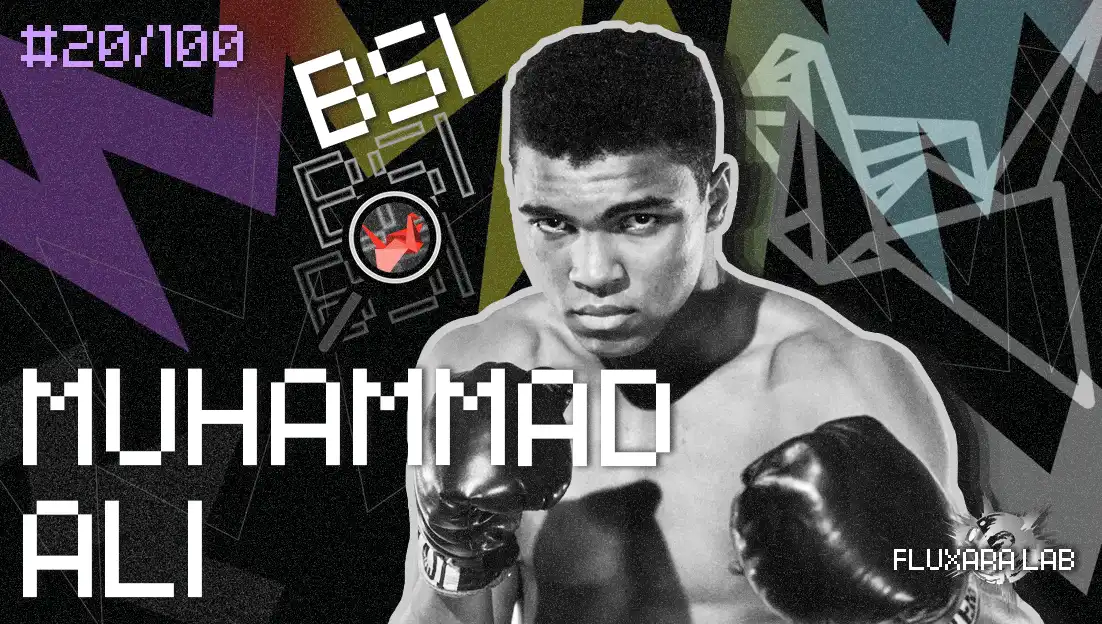
What this audit records
This public profile draws only on 15 matched records in the frozen FLUXARA-1 humanoid audit for Muhammad Ali. The visible timeline spans 1955–2022, with BSI values from 75.6% to 100.0% (mean 88.4%).
In this research frame, BSI describes the intensity of a biographical structural event; it is directionally agnostic. A high marker can therefore refer to crisis, breakthrough, institutional change, or durable legacy—not a moral judgement about the person or event. To learn more about how energy cycles impact individuals, read our analysis on what is a black swan person.
Tier distribution: Point Zero (PZ): 4 events (27%); Black Swan (BS): 4 events (27%); Shock Factor (SF): 4 events (27%); Fragility Baseline (FB): 3 events (20%).
The table below reproduces each verified event exactly as scored in the audit dataset. All events passed the four-gate evidence filter (Identity, Temporal, Source, Event Granularity) and received a [Matched] verification status. Rows marked by the source label as tolerance cases use the rubric's allowed ±1-year temporal window.
Verified BSI Trigger Timeline
| Year | BSI% | Tier | Label | Verified Event |
| 1955 | 85.5 | SF | Systemic Instability | In 1955, thirteen-year-old Cassius Clay experienced a profound psychological shock following the murder of Emmett Till, an event that catalyzed his early social awareness and manifested in acts of frustration, including the vandalism of a local rail yard. |
| 1959 | 93.3 | BS | Destructive Restructuring | In 1959: Muhammad Ali, then known as Cassius Clay, achieved a pivotal structural shift in his career by winning his second national Golden Gloves title and securing his status as a premier amateur boxer, a trajectory that rendered his local Louisville amateur life obsolete and propelled him toward his 1960 Olympic gold medal victory. |
| 1968 | 100.0 | PZ | Critical Disruption / Systemic Shock | In 1967, Muhammad Ali was stripped of his boxing titles and had his professional license suspended by the New York State Athletic Commission and other boxing bodies following his refusal to be inducted into the U.S. Armed Forces, an exclusion that rendered him unable to compete professionally for over three years. |
| 1973 | 77.2 | SF | Systemic Instability | In 1973: Muhammad Ali suffered a broken jaw during a fight against Ken Norton, which resulted in the second loss of his professional career and prompted him to briefly consider retirement from boxing. |
| 1977 | 100.0 | PZ | Critical Disruption / Systemic Shock | In 1977: Muhammad Ali's longtime physician, Ferdie Pacheco, resigned from his position after Ali's team ignored medical reports indicating that the boxer's kidneys were failing and that he should retire following a physically punishing bout against Earnie Shavers. |
| 1980 | 75.9 | FB | Directional Shift / Accumulation | In 1980: Muhammad Ali continued his professional training at his dedicated five-acre camp in Deer Lake, Pennsylvania, a site he had established in 1972 and utilized as his primary base for all preparations leading up to his retirement in 1981. |
| 1982 | 77.3 | SF | Systemic Instability | In 1982, following his retirement from professional boxing, Muhammad Ali transitioned into a new phase of life as Yolanda "Lonnie" Williams became his primary caregiver, a role that facilitated his continued education and personal management. |
| 1985 | 75.6 | FB | Latent Strain / Minor Adaptation | In 1985: Muhammad Ali settled a palimony lawsuit filed by Aaisha Fletcher by agreeing to establish a $200,000 trust fund for their daughter, Khaliah. |
| 1986 | 91.7 | BS | Destructive Restructuring | In 1984: Muhammad Ali received a formal medical diagnosis of Parkinson's Syndrome at the Presbyterian Hospital in New York, an event that permanently ended his physical operating baseline and necessitated a total recalibration of his public identity and life trajectory. |
| 1995 | 100.0 | PZ | Structural Metamorphosis / Career Pivots | In 1995, Muhammad Ali led a delegation of American and Japanese professional wrestlers, including Antonio Inoki and Ric Flair, on a sports diplomacy mission to North Korea, where he served as the guest of honor at the Collision in Korea event. |
| 2000 | 76.5 | FB | Directional Shift / Accumulation | In 2000: Muhammad Ali's grandson, Nico Ali, was born, marking the continuation of the family's involvement in professional boxing. |
| 2004 | 100.0 | PZ | Structural Metamorphosis / Career Pivots | In 2004: Muhammad Ali published his autobiography, in which he publicly detailed his conversion to mainstream Sunni Islam and his departure from the teachings of the Nation of Islam. |
| 2013 | 95.7 | BS | Legacy Resonance (Major — BS) | In 2013, the documentary film The Trials of Muhammad Ali, directed by Bill Siegel, and the television film Muhammad Ali's Greatest Fight were released, both focusing on the boxer's refusal of the military draft during the Vietnam War and significantly institutionalizing his historical legacy. |
| 2018 | 85.7 | SF | Legacy Resonance (Moderate — SF) | In 2018, professional wrestler John Cena was honored with the Muhammad Ali Legacy Award, an annual recognition presented by Sports Illustrated to figures who exemplify leadership and philanthropy. |
| 2022 | 91.4 | BS | Legacy Resonance (Major — BS) | In 2023, Muhammad Ali was formally inducted into the Team USA Hall of Fame, further institutionalizing his legacy within the American sporting canon. |
Structural Summary
Across 15 matched records, the peak BSI score of 100.0% occurs in 1968 (classified as Critical Disruption / Systemic Shock, PZ-tier).
PZ/BS ratio: 8 of 15 matched records (53%). Mean BSI score: 88.4%.
Age-band distribution, calculated as audit year minus the frozen birth-year profile: before age 18: 2 records (13%); ages 18–64: 10 records (67%); age 65+: 3 records (20%).
Temporal tolerance use: 3 records (20%) use the rubric's allowed ±1-year window.
The dominant event classifications are: Systemic Instability (3); Critical Disruption / Systemic Shock (2); Destructive Restructuring (2).
Data: FLUXARA-1 Humanoid Biographical Audit (96.51% verified in-sample match rate, 1,466 matched / 1,519 in-sample events). Methodology: four-gate evidence filter per the BSI Semantic Rubric v1.0. This analysis is part of a 100-figure audit series for academic research; it does not constitute life, financial, or medical advice.
No Guarantee of Future Projections: Out-of-sample projections are mathematically generated scenarios based on cyclical boundary equations and do not represent guaranteed forecasts.
Assumption of Risk: Any reliance on the materials, metrics, or scripts in this repository is at the user's sole risk. Fluxara Research Lab, its developers, and contributors assume no liability for any direct or indirect losses resulting from the use or interpretation of these assets.
Limitations & Structural Asymmetry (The 1,610 vs. 6,390 Problem): The current benchmark design exhibits a critical statistical constraint: it evaluates performance exclusively within the Alert-Tier Population (N = 1,610 years, where BSI ≥ 60%), achieving a 96.51% semantic match rate. While this validates the engine's Target-Event Precision, it does not define its Specificity or Type I Error Rate (False Positives) across the remaining ~6,390 non-alert background years within the audited 8,000+ year-pool. This asymmetry is primarily due to Information Omission Bias in public historical archives, where uneventful years lack structured validation data. Consequently, the 96.51% score must be interpreted as a measure of semantic consistency in crisis mapping, not as a complete proof of the engine's discrimination capacity. A stratified random-sample pilot to establish a validated True Negative baseline for the 6,390 background years is planned under our model risk management pipeline, but has not yet commenced.
Related Posts

#28 BSI Structural Analysis: Vincent van Gogh
FLUXARA-1 audit of 15 matched BSI events for Vincent van Gogh, spanning 1866–1938; the most frequent verified classification is Destructive Restructuring.

#29 BSI Structural Analysis: Virginia Woolf
FLUXARA-1 audit of 11 matched BSI events for Virginia Woolf, spanning 1888–1969; the most frequent verified classification is Destructive Restructuring.

#30 BSI Structural Analysis: Winston Churchill
FLUXARA-1 audit of 16 matched BSI events for Winston Churchill, spanning 1882–1959; the most frequent verified classification is Destructive Restructuring.
