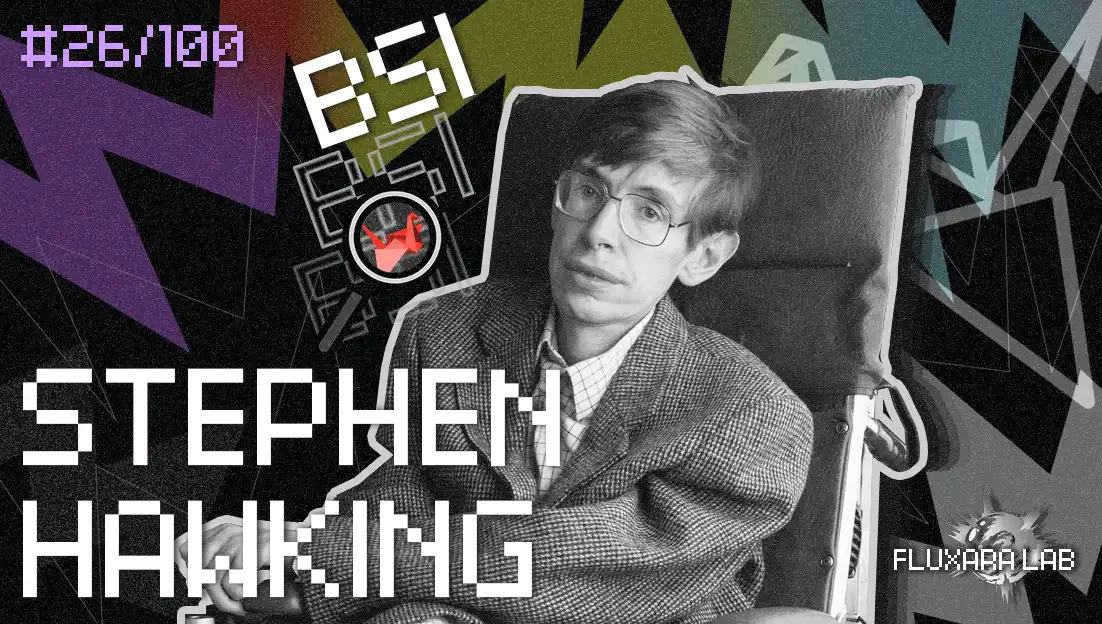
#26 BSI Structural Analysis: Stephen Hawking
What this audit records
This public profile draws only on 16 matched records in the frozen FLUXARA-1 humanoid audit for Stephen Hawking. The visible timeline spans 1950–2022, with BSI values from 75.6% to 100.0% (mean 89.1%).
In this research frame, BSI describes the intensity of a biographical structural event; it is directionally agnostic. A high marker can therefore refer to crisis, breakthrough, institutional change, or durable legacy—not a moral judgement about the person or event. To learn more about how energy cycles impact individuals, read our analysis on what is a black swan person.
Tier distribution: Point Zero (PZ): 5 events (31%); Black Swan (BS): 4 events (25%); Shock Factor (SF): 4 events (25%); Fragility Baseline (FB): 3 events (19%).
The table below reproduces each verified event exactly as scored in the audit dataset. All events passed the four-gate evidence filter (Identity, Temporal, Source, Event Granularity) and received a [Matched] verification status. Rows marked by the source label as tolerance cases use the rubric's allowed ±1-year temporal window.
Verified BSI Trigger Timeline
| Year | BSI% | Tier | Label | Verified Event |
| 1950 | 100.0 | PZ | Structural Metamorphosis / Career Pivots | In 1950: Stephen Hawking relocated with his family to St Albans, Hertfordshire, following his father's appointment as the head of the division of parasitology at the National Institute for Medical Research. |
| 1955 | 85.5 | SF | Systemic Instability | In 1955, the Hawking family relocated from Highgate, London, to St Albans, Hertfordshire, forcing thirteen-year-old Stephen Hawking to adapt to a new social and educational environment at St Albans School, which triggered a period of intense social alienation and accelerated his retreat into independent intellectual pursuits. |
| 1959 | 93.3 | BS | Destructive Restructuring | In 1959, at the age of 17, Stephen Hawking matriculated at University College, Oxford, to begin his studies in Natural Sciences, an event that marked the definitive transition from his secondary education into the high-stakes academic environment that would serve as the crucible for his future scientific career. |
| 1968 | 100.0 | PZ | Structural Metamorphosis / Career Pivots | In 1968, Stephen Hawking and Roger Penrose collaborated on a joint essay regarding singularity theorem concepts, which earned runner-up honors in the Gravity Research Foundation competition. |
| 1973 | 77.2 | SF | Systemic Instability | In 1973, Stephen Hawking and James M. Bardeen formulated the four laws of black hole mechanics, establishing a fundamental thermodynamic analogy for black holes that necessitated a significant strategic pivot in Hawking's theoretical research trajectory. |
| 1977 | 100.0 | PZ | Structural Metamorphosis / Career Pivots | In 1977: Stephen Hawking was appointed to a professorial chair in gravitational physics at the University of Cambridge, marking a significant advancement in his academic career and institutional authority. |
| 1980 | 75.9 | FB | Directional Shift / Accumulation | In 1979, Stephen Hawking transitioned his research methodology toward a more intuitive and speculative approach while simultaneously accepting the necessity of home nursing services due to his declining health following his appointment as the Lucasian Professor of Mathematics. |
| 1982 | 77.3 | SF | Systemic Instability | In 1982: Stephen Hawking made the strategic decision to write a popular science book to finance his children's education and home expenses, signing a mass-market contract with Bantam Books that marked a significant departure from his previous academic publishing trajectory. |
| 1985 | 75.6 | FB | Latent Strain / Minor Adaptation | In 1985: During a visit to CERN, Stephen Hawking contracted life-threatening pneumonia, which necessitated an emergency tracheotomy that resulted in the permanent loss of his speech and required the implementation of round-the-clock nursing care at his home. |
| 1986 | 91.7 | BS | Destructive Restructuring | In 1986: Stephen Hawking underwent a fundamental shift in his ability to communicate when he adopted the 'Equalizer' computer program, which allowed him to select phrases and words via a switch, permanently replacing his previous method of using spelling cards and marking the beginning of his lifelong reliance on computer-assisted speech. |
| 1995 | 100.0 | PZ | Structural Metamorphosis / Career Pivots | In 1995, Stephen Hawking finalized his divorce from Jane Wilde and subsequently married his nurse, Elaine Mason, marking a significant shift in his personal life and public identity. |
| 2000 | 76.5 | FB | Directional Shift / Accumulation | In 2000: Stephen Hawking, alongside eleven other humanitarians, signed the Charter for the Third Millennium on Disability, a formal commitment calling on governments to implement measures to prevent disability and protect the rights of disabled individuals. |
| 2004 | 100.0 | PZ | Critical Disruption / Systemic Shock | In 2003: Stephen Hawking publicly declared his opposition to the United States' invasion of Iraq, characterizing the military action as a war crime. |
| 2013 | 95.7 | BS | Destructive Restructuring | In 2013: Following the discovery of the Higgs boson at CERN in 2012, Stephen Hawking publicly conceded his long-standing bet against the particle's existence and acknowledged that Peter Higgs should receive the Nobel Prize for Physics, which was subsequently awarded that year. |
| 2018 | 85.7 | SF | Legacy Resonance (Moderate — SF) | In 2018: Following his death in March, Stephen Hawking's final book, 'Brief Answers to the Big Questions', was published in October, alongside his final research paper, 'Black Hole Entropy and Soft Hair', which addressed the fate of information within black holes. |
| 2022 | 91.4 | BS | Legacy Resonance (Major — BS) | In 2022: The "Stephen Hawking at Work" display opened at the Science Museum in London, marking the commencement of a two-year nationwide tour and the institutionalization of Hawking's personal office artifacts and scientific papers within the national collection. |
Structural Summary
Across 16 matched records, the peak BSI score of 100.0% occurs in 1950 (classified as Structural Metamorphosis / Career Pivots, PZ-tier).
PZ/BS ratio: 9 of 16 matched records (56%). Mean BSI score: 89.1%.
Age-band distribution, calculated as audit year minus the frozen birth-year profile: before age 18: 3 records (19%); ages 18–64: 10 records (62%); age 65+: 3 records (19%).
Temporal tolerance use: 3 records (19%) use the rubric's allowed ±1-year window.
The dominant event classifications are: Structural Metamorphosis / Career Pivots (4); Destructive Restructuring (3); Systemic Instability (3).
Data: FLUXARA-1 Humanoid Biographical Audit (96.51% verified in-sample match rate, 1,466 matched / 1,519 in-sample events). Methodology: four-gate evidence filter per the BSI Semantic Rubric v1.0. This analysis is part of a 100-figure audit series for academic research; it does not constitute life, financial, or medical advice.
No Guarantee of Future Projections: Out-of-sample projections are mathematically generated scenarios based on cyclical boundary equations and do not represent guaranteed forecasts.
Assumption of Risk: Any reliance on the materials, metrics, or scripts in this repository is at the user's sole risk. Fluxara Research Lab, its developers, and contributors assume no liability for any direct or indirect losses resulting from the use or interpretation of these assets.
Limitations & Structural Asymmetry (The 1,610 vs. 6,390 Problem): The current benchmark design exhibits a critical statistical constraint: it evaluates performance exclusively within the Alert-Tier Population (N = 1,610 years, where BSI ≥ 60%), achieving a 96.51% semantic match rate. While this validates the engine's Target-Event Precision, it does not define its Specificity or Type I Error Rate (False Positives) across the remaining ~6,390 non-alert background years within the audited 8,000+ year-pool. This asymmetry is primarily due to Information Omission Bias in public historical archives, where uneventful years lack structured validation data. Consequently, the 96.51% score must be interpreted as a measure of semantic consistency in crisis mapping, not as a complete proof of the engine's discrimination capacity. A stratified random-sample pilot to establish a validated True Negative baseline for the 6,390 background years is planned under our model risk management pipeline, but has not yet commenced.
Related Posts

#28 BSI Structural Analysis: Vincent van Gogh
FLUXARA-1 audit of 15 matched BSI events for Vincent van Gogh, spanning 1866–1938; the most frequent verified classification is Destructive Restructuring.

#29 BSI Structural Analysis: Virginia Woolf
FLUXARA-1 audit of 11 matched BSI events for Virginia Woolf, spanning 1888–1969; the most frequent verified classification is Destructive Restructuring.

#30 BSI Structural Analysis: Winston Churchill
FLUXARA-1 audit of 16 matched BSI events for Winston Churchill, spanning 1882–1959; the most frequent verified classification is Destructive Restructuring.
